

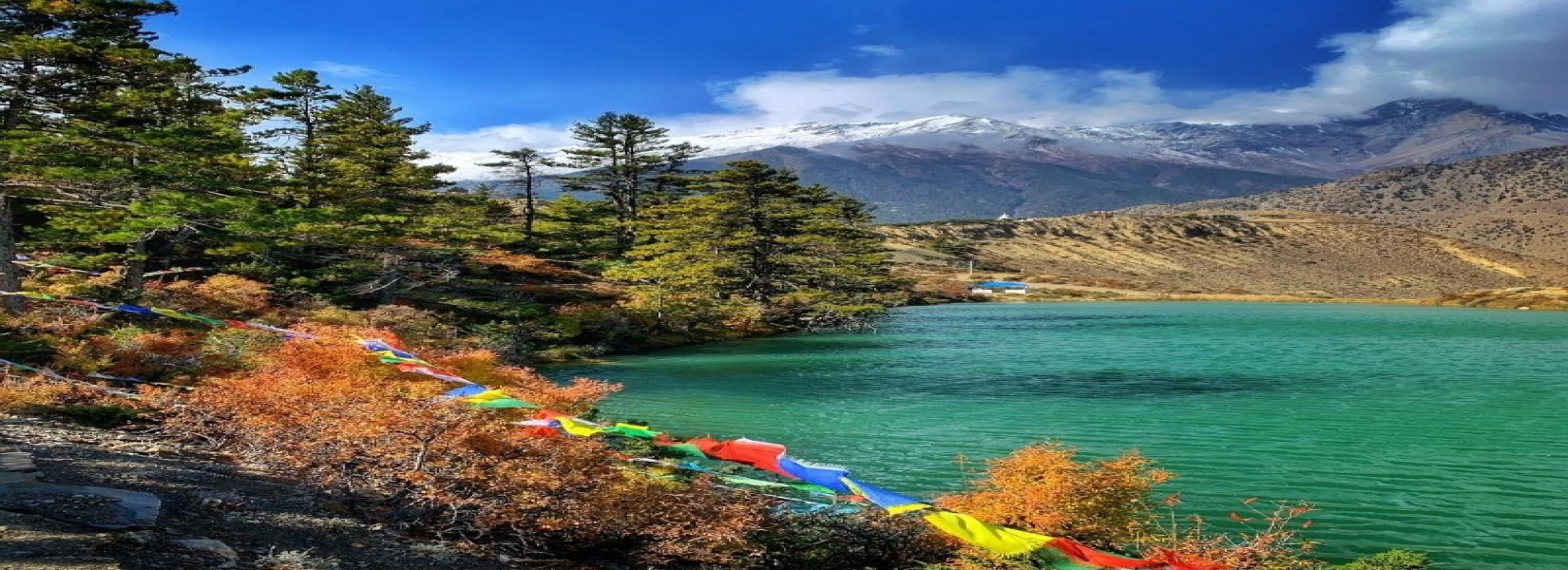
 Dhumba Lake – A Hidden Jewel at the Foot of Nilgiri
Dhumba Lake – A Hidden Jewel at the Foot of Nilgiri
DURATION: 7 DaysKey Information
-
Trip Duration 7 Days
-
Price from US$ 1350
-
Trip Grade NA
-
Trip Style NA
-
Accomodation NA
Dhumba Lake: A Hidden Jewel at the Foot of Nilgiri
At the foot of Mount Nilgiri, in Samle, Gharpajhong Rural Municipality, lies Dhumba Lake—a peaceful destination that is becoming one of Mustang’s most loved attractions. Sitting 2,830 meters above sea level, the deep-blue lake draws visitors with its natural beauty and spiritual significance.
Getting there has become easier in recent years. The lake is just three kilometers from the Jomsom–Korala highway, and the upgraded Gharpajhong Ring Road now provides a smooth route. Many travelers heading to Muktinath or returning from Korala in Upper Mustang stop here along the way.
Dhumba Lake is also known as Paan Butte Lake. Seen from above, its outline resembles a heart or a betel leaf, nestled among the mountains. The lake stretches about 130 meters, its blue waters reflecting the surrounding forests and the snow-covered slopes of Nilgiri. In the distance, Dhaulagiri and Mustang’s rolling hills complete the striking view.
A sacred place
The lake’s story is closely tied to Chhuks Terenga Monastery, which stands nearby. Local accounts say natural springs flowing from Nilgiri feed the lake.
Centuries ago, Lama Urgen Palsang of Thini returned from Tibet carrying five relics of Guru Padmasambhava. His teacher had instructed him to place them somewhere marked by four signs: a mountain shaped like an elephant’s trunk, smaller peaks on either side, the Kali Gandaki River below, and a lake to the north. The landscape around Dhumba Lake matched this description, and the relics were enshrined here. The site remains sacred to the Nyingma school of Tibetan Buddhism. During important rituals, the monastery uses water from the lake in blessings.
On the northern shore, a large white rock is believed to be the shrine of Nagdevata, the serpent deity and guardian of the lake. Fishing is forbidden. Instead, villagers release fish fry into the water as offerings during rituals. Endangered water birds can also be seen gathering quietly along the shore.
Caring for the lake
Dhumba Lake is an important part of local community life. The Chhuks Terenga Monastery Committee and the Jomsom, Thini, and Samle Conservation Committees, working under the Annapurna Conservation Area Project (ACAP), help protect and manage the site.
To make visits more comfortable, they have built stairways, railings, rest areas, covered spaces, and signboards. These improvements help visitors explore while preserving the lake’s peaceful atmosphere.
Visitor numbers rise during festivals such as Dashain and Tihar, as well as on special new moon days. Sunny Thakali, who runs a small restaurant nearby, says the lake can receive 200 to 500 visitors a day during busy periods. On quieter days, around 40 to 50 people come by, often stopping for tea and a view of Nilgiri reflected in the water.
A perfect stop in Mustang
There is plenty to explore nearby. The apple orchards of Marpha and Syang, the dryland farms of Thini and Samle, and the old villages along the Kali Gandaki make appealing side trips. Trails from the lake lead toward Jomsom, Chhuks Terenga Monastery, and the surrounding hills.
For me, a visit to Dhumba Lake was more than sightseeing. It was a moment of stillness, where nature and faith seemed woven together. Kathmandu visitor Soni Awaal captured that feeling: “Most lakes I’ve seen are crowded and noisy, but here I felt like I had stepped into another world.”
As I left, the setting sun turned the water golden, while prayer flags fluttered in the wind near the monastery. Dhumba Lake may be small, but it brings together the natural beauty, spiritual heritage, and warm hospitality that make Mustang unforgettable.
Itinerary
- 01Arrival in Kathmandu (1,400 m) Arrive in Kathmandu.
Explore Thamel in the evening or relax.
Overnight in Kathmandu.
- 02Kathmandu → Pokhara (822 m) Kathmandu → Pokhara (822 m)
Drive (6–7 hrs) or fly (30 min) to Pokhara.
Evening stroll around Phewa Lake.
Overnight in Pokhara.
- 03Pokhara → Jomsom (2,720 m) → Trek to Marpha (2,670 m) Pokhara → Jomsom (2,720 m) → Trek to Marpha (2,670 m)
Morning flight/drive to Jomsom.
Short and scenic trek to Marpha, famous for apple orchards and Thakali culture.
Explore the monastery and old stone-paved alleys.
Overnight in Marpha.
- 04Marpha → Thini Village → Dhumba Lake (2,830 m) → Jomsom Marpha → Thini Village → Dhumba Lake (2,830 m) → Jomsom
Trek to Thini village, one of the oldest settlements in Mustang.
Continue hike to Dhumba Lake, a sacred turquoise lake beneath Nilgiri Himal.
Enjoy views of barren Mustang landscapes and snow peaks.
Return trek to Jomsom for overnight.
- 05Jomsom → Kagbeni (2,810 m) → Muktinath (3,800 m) Jomsom → Kagbeni (2,810 m) → Muktinath (3,800 m)
Trek or drive along the Kali Gandaki valley to Kagbeni, gateway to Upper
Mustang.
Continue to Muktinath, a famous pilgrimage site for both Hindus and Buddhists.
Explore temples, monasteries, and natural flame (eternal burning fire).
Overnight in Muktinath.
- 06 Muktinath → Jomsom → Pokhara Muktinath → Jomsom → Pokhara
Flight or drive back to Pokhara.
Free evening in Pokhara.
Overnight in Pokhara.
- 07Pokhara → Kathmandu (1,400 m) Pokhara → Kathmandu (1,400 m)
Drive (6–7 hrs) or fly (30 min) back to Kathmandu.
Evening farewell dinner.
Overnight in Kathmandu.
Client Reviews
-

Bertrand & Delphine,France
our dream is to live in Buthan which you had organized
Thank you so much. Merry X-mas and Happy New Year to you & your company! You know our dream is to live in dhumba lake trekking which you had organized. We have plan to be back in pokhara & dhumba lake trekking on oct 2025 this is our s gift to Delphine and me. We…Read More...
GET EXCLUSIVE OFFERS & UPDATES